
In industrial environments where air can turn into an adversary, safety is not declared by a statement pinned to the wall. Safety is demonstrated by the instruments that accurately detect danger, when accuracy is all that stands between labor and loss. Calibration is a choice between assumption and certainty.
Gas detector calibration is the least expensive safety protocol required by the Occupational Safety and Health Administration (OSHA), yet it has far-reaching consequences. OSHA compliance is not about perfection, but demonstrating due diligence. This is where regulatory expectations meet technical realities.
Returning Gas Detector Sensors to Accuracy
Calibration is the process of aligning gas detector measurements with reality. It involves verifying and adjusting the gas detector’s sensor response to detect and quantify gas concentrations.
Due to exposure to the industrial environment, the sensor tends to drift. It’s one thing to be aware of the presence of dangerous gases, and another thing entirely to remain mindful of the permissible exposure limits.
Gas detection calibration services are mandated for OSHA compliance to ensure measurement accuracy, not functionality. Calibration preserves the detector’s status as a defensible safety protocol.
Why Do Sensors Drift?
The sensor is made up of chemical, electrochemical, infrared, or catalytic devices that degrade naturally. Without calibration, the sensor can under-report or over-report gas concentration, leading to missed or false alarms.
Common causes of sensor drift include:
- Aging
- Continuous exposure to low-level gases
- Environmental factors
- Sensor poisoning
- Temperature and humidity variations
- Mechanical shock
- Cross-sensitivity
Osha Compliance With Gas Detection
At its core, the Occupational Safety and Health Act regulates and safeguards workers from preventable injury, illness, and death. It’s not only a legal mandate but also a baseline expectation for employers to provide a work environment free of recognized hazards.
Hydrogen sulfide, carbon monoxide, methane, ammonia, and oxygen-deficient atmospheres are recognized hazards, provided they stay within permissible exposure limits. Gas detector calibration is a critical component in this equation.
There is no universal standard for sensor calibration frequency, but employers must ensure the detectors provide accurate readings. This obligation is either implicit or explicit, depending on the industry.
Performance-based Approach for Gas Detector Calibration
OSHA compliance over detector calibration is based on performance. Instead of mandating a calibration after a specified period, OSHA offers employers flexibility in meeting this requirement but requires evidence that the chosen frequency works.
In this performance-based approach, OSHA wants to know:
- What controls has the employer put in place?
- Can the operator prove the readings were accurate at the time they were relied upon?
- How did the employer confirm that the readings are accurate?
Permissible Exposure Limits
Gas detection calibration services maintain calibration records for the employer to present during an OSHA audit. These records detail procedures and traceability. They are key to demonstrating the plant operates under acceptable limits.
OSHA has established a long list of recognized hazardous gases and their permissible exposure limits. Compliance with these standards is dependent on the gas detector’s measurement accuracy.
For example:
- Hydrogen sulfide has a 20 ppm ceiling
- Carbon monoxide exposure is limited to 50 ppm per 8-hour TWA
- Oxygen deficiency below 19.5% is uninhabitable
An uncalibrated gas detector can give false readings, giving a false sense of safety or danger. This uncertainty is a direct violation of OSHA exposure standards. The employer has the duty of care and responsibility for the usefulness of safety equipment.
The Moral Bridge Between Calibration and OSHA Compliance
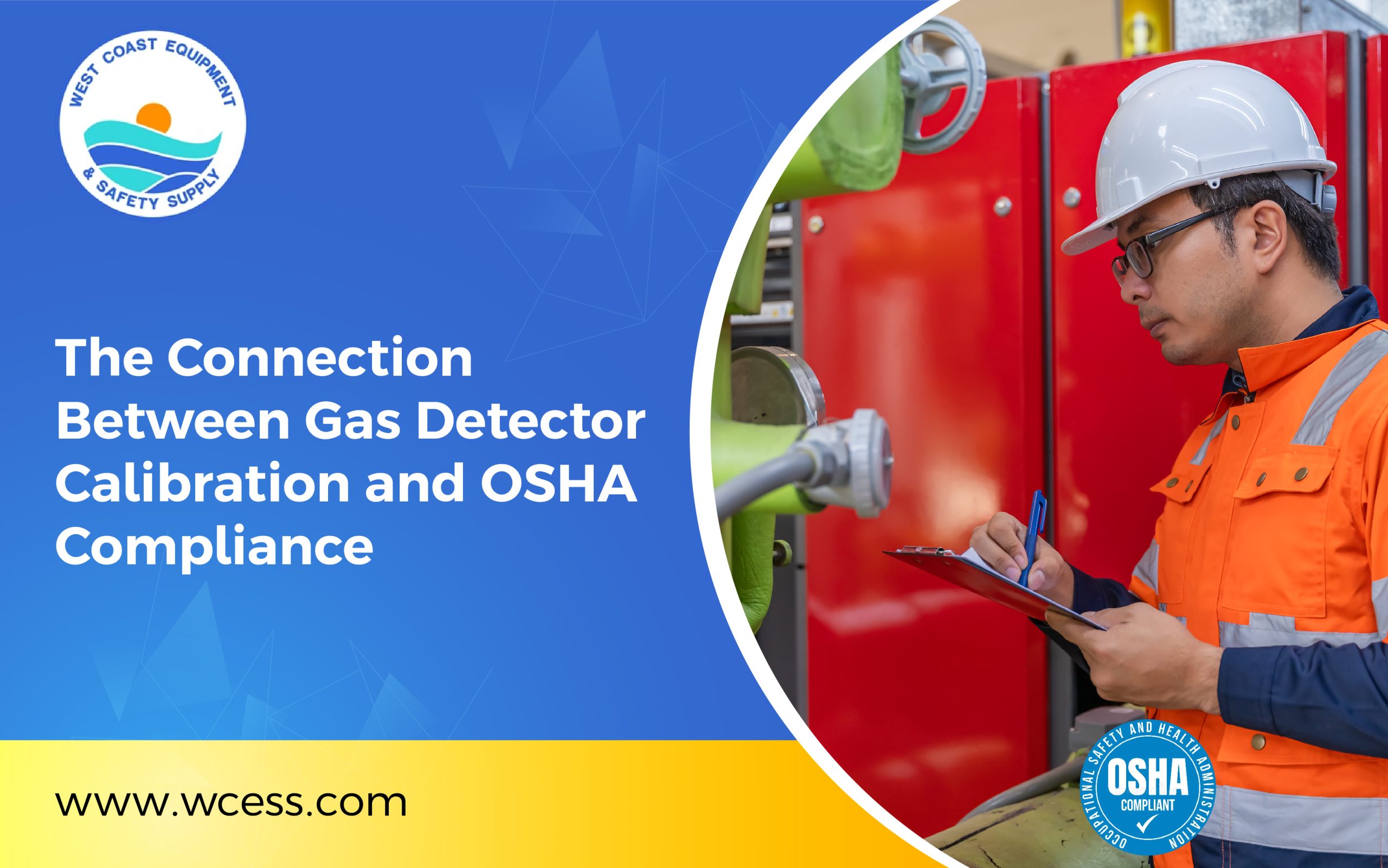
An OSHA inspector will scrutinize calibration schedules and policies, certificates and logs, to determine whether the gas detector was calibrated according to documented procedures. A missing or inconsistent record can be grounds for shutting down operations.
Gas detector calibration is a key focus in investigating accidents and near misses. From an OSHA perspective, calibration did not happen unless it was documented. It is the measurable act that demonstrates an employer’s commitment to worker safety.
Conclusion
Gas detector calibration is the practical proof of OSHA compliance. Accurate readings, supported by proper records, ensure hazards are identified within permissible limits and safety decisions are defensible. By correcting sensor drift and preserving reliability, calibration protects both workers and operations. West Coast Equipment & Safety Supply helps organizations keep safety measurable, compliant, and ready when it matters most.
Also Read: How Often Should You Calibrate Gas Detectors? A Complete Guide